
Ashe County Parole vs Probation
Release from custody and release from a sentence are not the same event. Probation usually follows a court judgment that permits supervision in the community instead of, or after, a jail term. Parole is a discretionary form of release that chiefly remains relevant to older or specially eligible North Carolina sentences. Post-release supervision is the statutory community phase that follows prison for most people sentenced under Structured Sentencing. The North Carolina Department of Adult Correction, or NCDAC, manages community supervision, while the North Carolina Post-Release Supervision and Parole Commission has distinct authority over parole and post-release supervision.
A person can be out of the Ashe County Detention Center yet still have an active criminal case, probation term, or state supervision record. Conversely, a blank county jail release field does not prove probation. Read the court judgment and the NCDAC label together.
| Supervision type | How it begins | Best public check |
|---|---|---|
| Probation | Ordered by a court as part of a judgment | NCDAC Offender Search and the court case |
| Parole | Commission release for an eligible sentence | NCDAC status and Commission records |
| Post-release supervision | Statutory phase after release from state prison | NCDAC status, sentence data, and supervising office |
- Discharge
- The formal end of supervision or the sentence, as the controlling record states.
- Absconder
- A supervised person whom authorities report is avoiding supervision and cannot be located.
- Detainer
- A request or hold from another authority that can affect custody or movement.
Verify Ashe County Post-Release Supervision
The public starting point is the NCDAC Offender Search. It contains state prisoners, probationers, parolees, and historical records, but it does not contain Ashe County jail-only records. Use the offender number when known. A name search needs a second identity point, such as birth date, age, conviction facts, or the county on the supervision record.
- Select the “Active Probationer/Parolee” status filter when current supervision is the question.
- Enter the offender number, or search by name with another identifying detail.
- Open the offender-number result and compare identity, conviction, sentence, and status.
- Read the supervision type and community county exactly as displayed. Do not turn post-release supervision into parole.
- Check the current Community Supervision office directory to identify the responsible office.
- Use the Ashe court case when the legal terms, start date, or court-ordered probation outcome needs confirmation.
An inactive result can mean the person was once active in NCDAC but is not active now. It does not, by itself, explain how the term ended. For a full release and case check, follow the source order on the Ashe County released inmates search, where Sheriff, NCDAC, and court records are kept in their proper roles.
Note: A public status confirms the broad supervision category, while confidential notes, reports, and private treatment details remain outside the public lookup.
Ashe County Supervision Office Records
NCDAC’s field roster dated September 11, 2025 placed Ashe County in Judicial District 23. It listed the Ashe-area office in West Jefferson. Staff names and individual assignments can change, so the current directory should control before a visit or call. The office can help identify the responsible field location, but it should not be treated as a source for confidential supervision files.
NCDAC Community Supervision, Ashe-area office1203 South Jefferson Avenue
P.O. Box 1909
West Jefferson, NC 28694
Phone: 336-246-6840
Fax: 336-246-7741
The statewide Community Supervision office is at 2020 Yonkers Road in Raleigh and lists 919-716-3100. A transferred supervision case may move to another North Carolina district or another state. The local office address is therefore a routing point, not proof that a named person must report there.
Ashe County Absconder Status Checks
Community supervision can include conditions set by the court or Commission. Public sources support a high-level status check, not a complete account of private conditions or contacts with an officer. A violation allegation also does not establish that supervision ended. It may lead to added review, a court or Commission response, arrest, or revocation, depending on the legal authority and facts.
NCDAC maintains a separate Absconder Search that accepts a surname and supervision county. “Absconder” has a specific meaning: the agency reports that a person under supervision is avoiding supervision and cannot be located. That result signals an active supervision issue. It is not proof of discharge and not proof of a new conviction.
Identity must still be checked. Names repeat, and supervision county may differ from arrest county or residence. NCDAC publishes 1-888-646-0024 as its tip line through Constituent Services. Do not approach or try to detain someone. For urgent danger, use emergency services rather than a record portal. Interstate supervision adds another layer. NCDAC links to the Interstate Compact public tracking resource from its criminal search guide. A North Carolina case can be supervised in another state under the compact, while the sentence still belongs to North Carolina. Check the public transfer status and then identify the current supervising jurisdiction. Do not assume that an Ashe County record became inactive merely because the person moved.
Note: A transfer to another state can leave the North Carolina sentence in force even when the Ashe office is no longer the daily contact.
How Ashe County Supervision Ends
Supervision ends through the legal process tied to its type. A probation judgment sets the court-controlled term and disposition. Parole and post-release supervision operate under the Commission and state sentence rules. For post-release supervision, G.S. 15A-1368.2 provides that completion terminates the sentence under the statute. A prison release date can therefore come before a later supervision termination date.
Use the latest NCDAC record for the public status, then use the Ashe court judgment or responsible agency record when the exact basis for discharge matters. NC SAVAN can issue a supervision-termination or custody-change notice in an eligible record, but an alert is not a discharge certificate. North Carolina public-record law also does not open every supervision file. NCDAC distinguishes public basic conviction, admission, and release facts from confidential internal correctional and supervision material.
A later booking for a probation or post-release violation does not erase the older release. It creates a new custody episode. Compare offender number, booking date, movement date, and case number so the old release and new event are not merged. NC SAVAN may provide a custody or supervision event alert when the relevant record supports it. Register against the Ashe jail ID for a county custody event and the DAC offender number for a state event. The same name is not enough to link those records. A termination alert should be checked against NCDAC status, just as a jail-release alert should be checked against the Sheriff’s booking and release record.
Keep the date of each lookup. A record can change from active supervision to inactive after discharge, or return to active custody after a violation event. A saved date and offender number make that sequence clear without assuming that the newest status describes every earlier point in the case.
Ashe County Parole Review Records
North Carolina does not publish a conventional calendar of formal offender parole hearings. The Post-Release Supervision and Parole Commission says commissioners review files individually and decide by majority vote without meeting personally with offenders. That distinction matters when checking an Ashe County parole question. The absence of a hearing date is not the absence of review. The official substitute is the Commission’s monthly Discretionary Parole Reviews index. Name-level monthly reports began in September 2024 and combine reviews with decisions. Outcomes can include Regular Parole, Community Service Parole, Early Medical Release, 90-day Mandatory Parole, Incomplete Decision, or Suspend Decision. The limited report does not open the entire Commission file.
The Commission’s official overview shows how parole review differs from routine probation supervision.
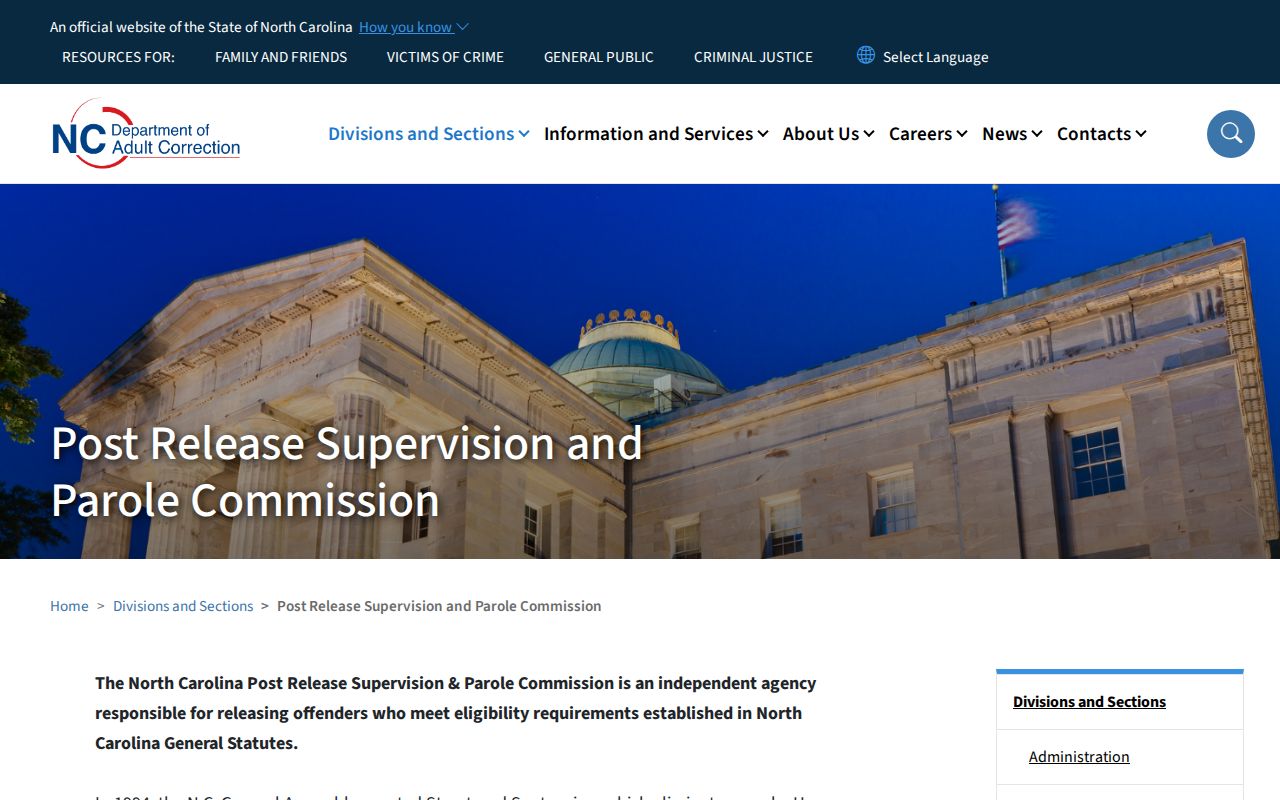
For most offenses committed under Structured Sentencing, ordinary parole is not the expected release path. Older offenses and narrow categories can remain eligible, and G.S. 15A-1371 makes eligibility sentence-specific.
Victim-input meetings are another distinct process. The Commission’s official guide describes weekly appointments rather than offender hearings. Those meetings are ordinarily thirty minutes, have limits on participation, and use scheduling tied to expected consideration. They should not be presented as a public parole-hearing calendar. The monthly review and decision index remains the public name-level source for the limited outcomes it reports.
Ashe County Reentry Care
The Ashe County Sheriff’s Medication Assisted Treatment program is a distinct local bridge between detention and community care. The published program combines clinical screening, medication, behavioral health services, peer support, reentry planning, links to community care, and follow-up. It addresses continuity of care, not proof of parole or probation status.
Published material does not list a full eligibility test or name all partner providers. A person or family should ask the Sheriff about the current program rather than infer enrollment from a release record. Participation also should not be treated as a public supervision condition unless an authoritative record actually says so. The program’s value is local and practical: it shows that release planning in Ashe County can involve care coordination alongside, or apart from, formal NCDAC supervision.
Note: Treatment participation and public supervision status are separate facts and should never be inferred from one another.